

Hello Everyone,
We wanted to start off today with a little creative exercise. If you are game…keep reading!
Imagine you’re going to the movies to see whatever new movie Ryan Gosling is in. Part of the fun is allowing ourselves to indulge in the treats that come with the movie going experience, while watching Ryan dance and sing, most especially the popcorn. When you place your order at the counter, you expect the popcorn to be fresh, perhaps lightly buttered with a hint of salt. Delicious.
Now what if instead of getting fresh popcorn, you were given popcorn that was 14 days old, in either a medium sized or large sized bucket. The popcorn still tastes the same either way, has been aged the same amount – it is merely in a different bucket. Do you think when you got to your seat, you would eat the same amount of popcorn, regardless of the staleness or container you were holding in your hand?
The intuitive answer, is of course NO. Why would I eat more “bad” popcorn!? Who cares what you handed it to me in, or how much of it I had. Bad popcorn is bad popcorn! We demand and deserve the best…especially when watching the best (Ryan Gosling).
Well, what if I told you that you would likely be completely wrong! In a study from 2005, researchers from Cornell University discovered that people ate, on average, 34% more of the popcorn when it was in a larger bucket compared to when it was served in a smaller bucket.
Doesn’t make sense, does it? The popcorn for the moviegoers tasted the same, and produced the same experiences – yet just because of the quantity before them, almost everyone opted to eat more of the “stale”, “terrible” popcorn.
This got me thinking about human movement, I know sort of a weird jump. Especially with how often we try to get clients and patients to focus on the health and available capacity of each of their joints, and why we often settle for simply “okay”.
If we consider the popcorn study in a different light, I wonder, that even though people might occasionally feel pain in a given tissue, if they had more opportunity to move in space (aka a bigger bucket) would they be more likely to “play” or seek more solutions considering their task in a given environment ultimately leading them to find an answer that “works” before stopping the movement altogether or thinking something was wrong.
In other words, if movement is how we solve problems in space, if we have more possible solutions, we should be able to solve more problems even despite their ever changing complexity. In the example I drew below, we consider the squat. If I gave you a task of the “squat”, obviously there are hundreds of contexts we can think of that might affect this movement, but let’s keep it simple for now and merely think of the squat as an everyday motion for sitting, lifting things up, and for the other normal functions of the day to day lives, for our “average” patient.
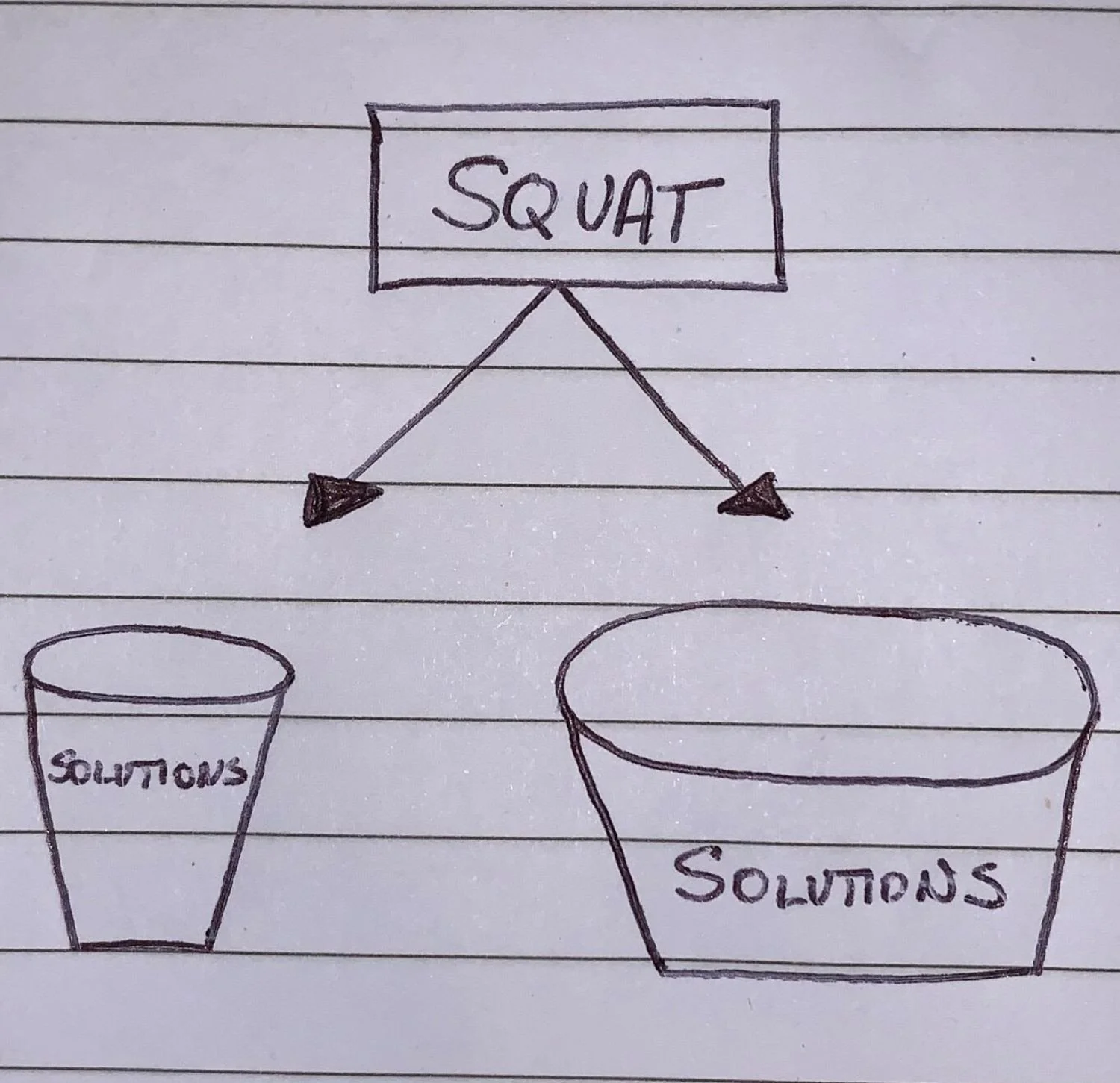
Here the choices are simple. I give you a problem and I ask that you use movement to solve it. Let’s say in bucket one you have 100 solutions, and 10 of them would produce an undesirable effect like pain or limited performance. In bucket two, however, you have 200 solutions with the same amount of undesirable chances (still 10). If considered this way then every time we squat with the available solutions in the first bucket we would have a 10% chance of experiencing pain and limited outcomes.
However, if we had more options for movement, like those in bucket 2, we would lower our chances of a negative outcome to 5%! If you knew you had more chances, with an increased likelihood at good results, would you be more likely to continue moving/exploring those options – much like the popcorn eaters continued to eat bad popcorn? Options create opportunity, and opportunity gives you the chance for success, especially when you control the variable. For all of us, we can choose when we go to the gym, what exercises to perform, when to take a rest day, when to focus on our mobility or when to seek out a movement practitioner that can guide us. The more variables we control, the better we are able to focus on the task when we perform it (in this case the squat) because we can focus on the goal of the movement, rather than “will this hurt me?” or “do I have enough strength/range of motion to do that?”
If I have a better functioning hip, knee, ankle or back, it does not guarantee I will never have pain, but it gives me a much better chance at modifying my movements within the context of my environment, reducing the chance of injury or having to cease an exercise/sport/etc because of continued pain.
Expand your bucket, fill it by sticking to a system that allows you to enhance your movement, and I promise that you will see the results you are striving for – be it with resolution of pain or improvement or performance, the more solutions we have the more likely we will be to succeed.
Also, life is too short to settle for bad popcorn! Let’s set up an appointment so we can expand your bucket.